From Spreadsheets to Software: How Program Admins Can Reclaim 20+ Hours Per Cycle

How the right software eliminates the manual coordination that quietly eats a program admin's cycle
If you manage scholarships, grants, or awards, you already know the cycle: Applications come in, Reviewers need assignments, Scores must be consolidated, Leadership wants reports…..and somehow, it all lives in spreadsheets.
What feels manageable at first quickly becomes 20–40 hours of manual coordination per cycle. There is a better way
The Spreadsheet Trap
Spreadsheets are flexible. But they create hidden workload:
Manual eligibility checks
Email-based reviewer assignments
Copy-pasting scores
Version control issues
Last-minute reporting stress
Multiply that across hundreds of submissions, and the administrative burden grows fast.
This is where awards management software changes everything.
What Is Awards Management Software?
Awards management software (also called a scholarship management system or grant review software) is a centralized platform that manages:
Applications
Reviewer assignments
Scoring
Communications
Reporting
Instead of juggling email, spreadsheets, and shared drives, everything runs in one structured system.
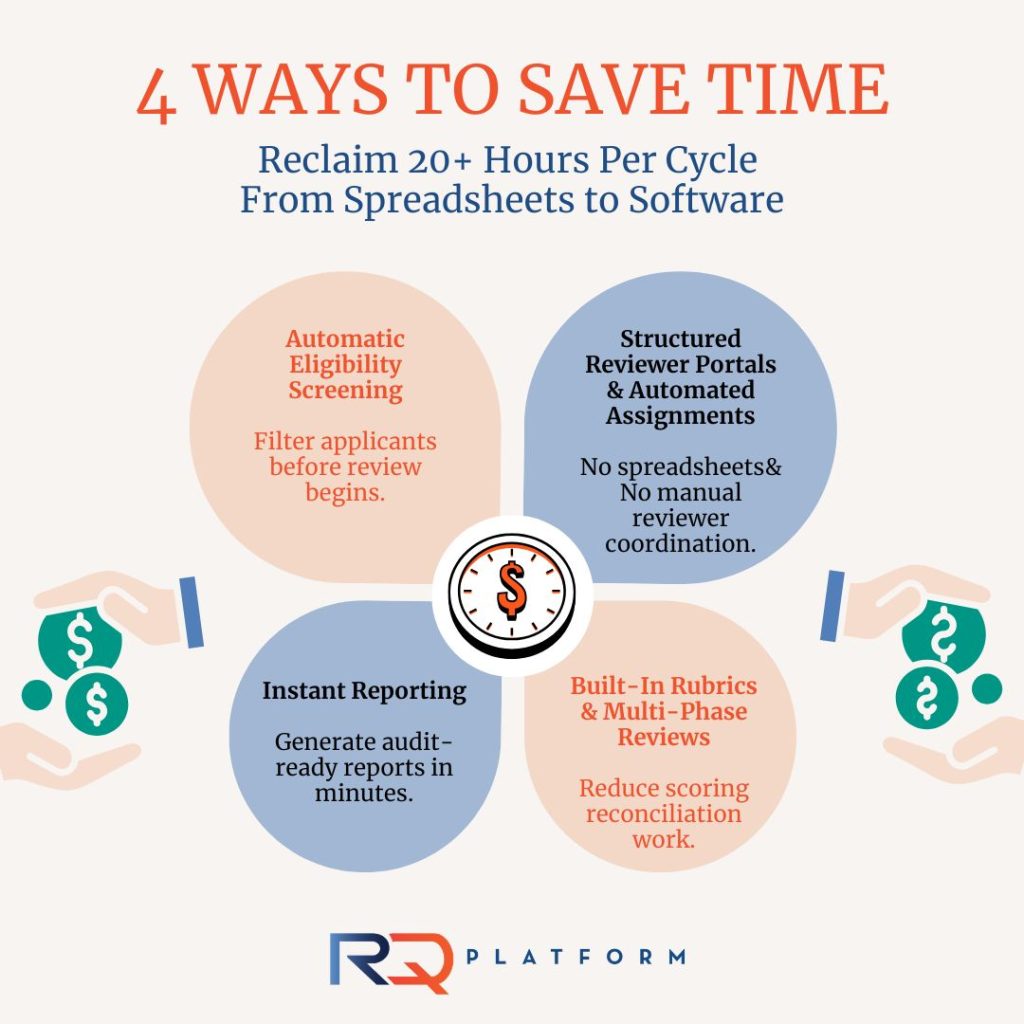
How Software Saves 20+ Hours Per Cycle
Here is where the time comes back:
1. Automatic Eligibility Screening
Applicants are filtered based on predefined criteria before reaching reviewers.
2. Structured Reviewer Portals
Reviewers log in, score using a built-in rubric, and submit directly in the system. No spreadsheets required.
3. Automated Assignments
Reviewer matching eliminates hours of coordination.
4. Built-In Rubrics & Multi-Phase Reviews
Structured scoring improves fairness and reduces reconciliation work.
5. Instant Reporting
Generate reports and audit trails in minutes instead of merging multiple files. This is where 20+ hours per cycle disappear from manual logistics and repetitive coordination.
When Is It Time to Move Beyond Spreadsheets?
It may be time to upgrade if you:
Manage 150+ applications per cycle
Run multiple review phases
Coordinate five or more reviewers
Spend days compiling final reports
Spreadsheets work until scale breaks them.
Common Questions About Moving From Spreadsheets to Software
How do we actually know if we've outgrown spreadsheets, versus just having a busy cycle?
A busy cycle is temporary; outgrowing spreadsheets shows up as a recurring pattern, the same version-control mix-ups, the same last-minute reporting scramble, the same manual reviewer coordination, cycle after cycle. If you're re-solving the same coordination problems every time instead of the work getting easier, that's the signal. RQ Platform is built specifically to remove that recurring coordination burden rather than just organizing it better on a spreadsheet.
Will switching to software mean a steep learning curve for our reviewers?
Reviewer-facing software is usually simpler than the spreadsheet workaround it replaces, not more complex. In RQ Platform, reviewers log in, see exactly what's assigned to them, and score directly against a built-in rubric there's no macro-laden spreadsheet template to learn, no separate email thread to track, and no risk of overwriting someone else's version.
Can one platform actually handle scholarships, grants, and awards, or do we need separate systems for each?
One platform can handle all three. RQ Platform supports scholarship management, grant review, and awards management within the same system, so programs running more than one type of application cycle don't need to maintain separate tools, separate logins, or separate reporting processes for each.
Where does the 20+ hours per cycle actually go today, specifically?
Mostly into work that doesn't require human judgment: manually checking eligibility, emailing reviewers to confirm assignments, copy-pasting scores into a master sheet, and rebuilding reports from multiple files. RQ Platform automates each of those specific steps, eligibility screening, reviewer assignment, score consolidation, and reporting which is exactly why the time savings land in that range rather than being a vague estimate.
Will our reporting to leadership or a board look different once we move off spreadsheets?
It typically gets faster and more consistent, not just different. Instead of manually merging multiple files before a board meeting, RQ Platform generates reports and audit trails directly from the same data reviewers and admins have been working in all cycle, so what leadership sees reflects the actual process rather than a reconstruction of it.
Final Takeaway
Program administrators should not spend their time chasing spreadsheets.
With the right awards management software, scholarship management system, or grant review software, you can:
Streamline workflows
Reduce errors
Reclaim 20+ hours per cycle
Focus on improving the program itself
If spreadsheets are consuming your cycle, the solution is not working harder. It is upgrading the system.
READY TO SIMPLIFY YOUR PROGRAM?
Your Program Deserves Better Than Spreadsheets.
RQ Platform brings applications, reviews, communications, reporting, and program management together—so your team can spend less time on admin and more time creating impact.