How to Measure Mentorship Relationship Quality

A practical guide to measuring trust, communication, and growth to understand how well your mentoring relationships are working.
Most mentorship programs rely on simple indicators such as match rates, attendance, and meeting counts. These metrics are helpful for tracking participation, but they do not answer the most important question: Is the mentorship relationship actually working?
As mentorship programs evolve in 2026, administrators are looking beyond activity-based metrics to something more meaningful: relationship quality. This deeper approach helps organizations understand whether mentors and mentees feel supported, aligned, connected, and able to grow together.
This guide explains how to measure relationship quality, which indicators matter most, and how RQ Mentorship can help you track the signals that contribute to successful mentoring relationships.
TL;DR
Activity metrics are useful, but they do not tell you whether a mentorship relationship is successful.
Relationship quality is influenced by trust, communication, alignment, support, and growth.
Programs should track communication health, expectations, goal progress, satisfaction, engagement, and long-term outcomes.
RQ Mentorship provides tools to help administrators measure these indicators throughout the mentorship lifecycle.
What Is Relationship Quality in Mentorship?
Relationship quality describes the strength and effectiveness of the connection between a mentor and mentee. It reflects the elements that make mentorship meaningful and productive, including:
Trust and psychological safety
Respect and openness
Comfortable, consistent communication
Shared expectations
Progress toward goals
A sense of support and belonging
Together, these factors can create mentorship relationships that deliver value during the program and long after the formal mentorship cycle ends.
Why Match Rates and Meeting Counts Are Not Enough
Activity indicators tell you what is happening in your mentorship program, but they do not necessarily tell you how well the relationship is working.
Match Rates
A high match rate shows that your program is successfully pairing participants. It does not tell you whether those matches develop into productive relationships.
Meeting Counts
Frequent meetings can be a positive sign of engagement, but more meetings do not automatically mean better conversations, stronger connections, or meaningful progress.
Completion Rates
A mentor and mentee may complete the program because they reached the end of the scheduled cycle, not necessarily because the relationship was successful.
To understand whether your mentorship program is truly effective, you need to look at what happens within the relationship, not just the activity surrounding it.
That is where measuring relationship quality becomes important.
How to Measure Mentorship Relationship Quality
Once you move beyond basic participation metrics, the next step is identifying the indicators that define a healthy, productive mentoring relationship.
The following eight areas can give you a more complete picture of each match.
1. Communication Quality
Healthy communication is the foundation of effective mentorship.
Look for signs such as:
Responsiveness and reliability
Comfortable, open dialogue
Clear communication
Productive meetings
Consistent follow-through
How RQ Mentorship helps:
RQ Mentorship can use surveys and structured feedback to help programs gather insights into communication and engagement throughout the mentorship cycle.
2. Trust and Psychological Safety
Strong mentoring relationships depend on participants feeling comfortable enough to communicate openly, ask questions, discuss challenges, and give or receive feedback.
Indicators can include:
Comfort discussing challenges
Willingness to ask for help
Respectful feedback
Mutual understanding
Confidence sharing concerns
Private participant feedback can help administrators identify relationships that may require additional support or guidance.
3. Goal Progress
A strong mentorship relationship should create momentum toward meaningful goals.
Track indicators such as:
Whether goals were established early
Progress toward milestones
Increased confidence or clarity
Skill development
Completion of agreed-upon tasks
RQ Mentorship allows participants to establish goals and track progress, giving both participants and program administrators greater visibility into development throughout the relationship.
4. Alignment of Expectations
Misaligned expectations can create frustration for both mentors and mentees.
Consider measuring whether participants agree on:
Meeting frequency
Preferred communication methods
The purpose of the relationship
What success should look like
The roles and responsibilities of the mentor and mentee
Setting these expectations during onboarding and revisiting them through check-ins can help prevent misunderstandings later in the program.
5. Support and Encouragement
Mentorship is not only about completing tasks or achieving professional goals. The quality of the relationship itself matters.
Consider asking mentees:
Do you feel supported by your mentor?
Does your mentor provide helpful encouragement?
Do you feel comfortable discussing challenges?
Has the relationship helped increase your confidence?
Qualitative feedback like this can reveal important insights that activity metrics alone cannot provide.
6. Engagement Patterns Over Time
A single engagement metric only provides a snapshot. Looking at engagement over time can reveal important changes in the health of a mentorship relationship.
Track patterns such as:
Meeting frequency
Changes in responsiveness
Participation in program activities
Progress on goals and tasks
Engagement compared with earlier stages of the relationship
A noticeable decline in engagement may indicate that a pair needs additional support.
7. Mentor and Mentee Satisfaction
Participant satisfaction is another valuable indicator of relationship quality.
Ask mentors and mentees:
How valuable has the mentorship been?
Are your expectations being met?
Do you feel the relationship is progressing?
Would you participate in the program again?
Would you recommend the program to others?
Rather than waiting until the end of the program, collect feedback at multiple points throughout the mentorship cycle. This gives administrators an opportunity to identify issues while there is still time to address them.
8. Long-Term Outcomes
Some of the most meaningful results of mentorship may not appear until after the formal program has ended.
Long-term outcomes can include:
Career or academic advancement
Increased confidence or career clarity
Continued mentor-mentee relationships
Leadership development
New professional or educational opportunities
Continued involvement in the organization
With RQ SmartTracker™, organizations can follow up with participants after the formal program ends to collect information about longer-term outcomes and better understand the lasting impact of their mentorship initiatives.
How RQ Mentorship Makes Measuring Relationship Quality Easier
Tracking relationship quality manually can quickly become difficult, particularly when you are managing dozens, hundreds, or even thousands of participants.
RQ Mentorship brings participant, relationship, and program information together so administrators can better understand how their mentorship program is performing.
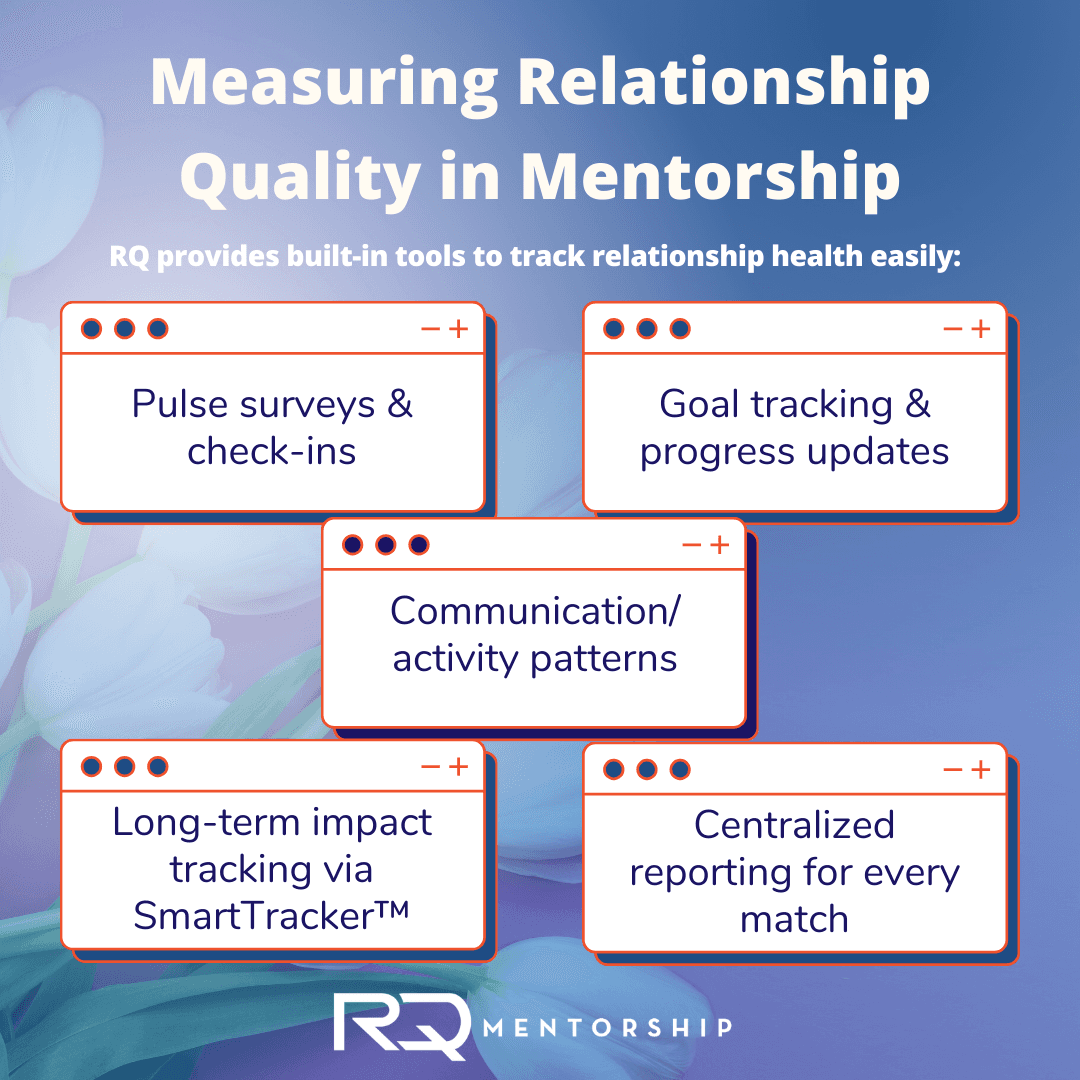
Depending on your program configuration, you can use RQ Mentorship to support:
Surveys and participant check-ins
Engagement and activity reporting
Goal setting and progress tracking
Mentor and mentee feedback
Satisfaction measurement
Identification of relationships that may need attention
Long-term follow-up with RQ SmartTracker™
Centralized program reporting
Instead of relying on meeting counts alone, administrators gain a more complete picture of participation, progress, and the health of mentoring relationships.
FAQs
Why is relationship quality important in mentorship programs?
Relationship quality helps organizations understand whether mentors and mentees are building the trust, communication, support, and alignment needed for a productive mentoring experience. These insights provide important context that participation metrics alone cannot offer.
What is the best way to measure mentorship success?
Use a combination of quantitative and qualitative indicators. Track participation and engagement alongside communication quality, trust, goal progress, participant satisfaction, and longer-term outcomes.
Do match rates and meeting counts still matter?
Yes. Match rates, meeting counts, and completion rates are valuable operational metrics. However, they should be considered alongside relationship-quality indicators to provide a more complete picture of mentorship success.
How does RQ Mentorship support relationship measurement?
RQ Mentorship helps organizations centralize participant information, track engagement and goals, collect feedback, and monitor program progress. These insights can help administrators better understand both individual relationships and overall program performance.
How can administrators identify mentorship relationships that may need support?
Look for indicators such as declining engagement, inconsistent communication, stalled goals, mismatched expectations, or negative participant feedback. Identifying these signals early gives program administrators an opportunity to provide additional guidance or support.
Relationship Quality Is an Important Measure of Mentorship Success
A mentorship program is only as successful as the relationships it helps create.
When mentors and mentees feel supported, aligned, engaged, and able to make meaningful progress, your program can deliver value that goes far beyond match rates and attendance.
RQ Mentorship helps organizations gain greater visibility into the mentoring experience by bringing engagement, goals, feedback, and program insights together in one place.
With better information, you can identify relationships that need support, understand what is working, improve future program cycles, and build a mentorship experience that makes a lasting difference.
Mentorship Management
Measure What Matters in Your Mentorship Program
Go beyond match rates and meeting counts. See how RQ Mentorship can help you manage mentoring relationships, track engagement and progress, collect participant feedback, and gain clearer insights into your program's impact.