How to Reduce Application Review Time by 40% Without Adding Staff

A practical blueprint for cutting review cycles by 30–40% through parallel workflows, dashboards, and blinded scoring
Operational Efficiency & Review Time Reduction
Most award and grant program administrators face the same frustration: review processes that drag on for weeks or months, consuming countless staff hours and delaying decisions.
The typical culprit? Disconnected systems and manual coordination.
When applications are scattered across email, spreadsheets, or basic platforms, reviewers struggle to find files, program managers have no visibility into progress, and bottlenecks emerge that nobody spots until deadlines slip.
But this doesn't have to be the case. Leading programs, particularly those managing 500+ applications, have discovered that the right platform can compress review cycles from 6-8 weeks to 4-5 weeks without hiring additional reviewers.
This isn't about working harder. It's about working smarter.
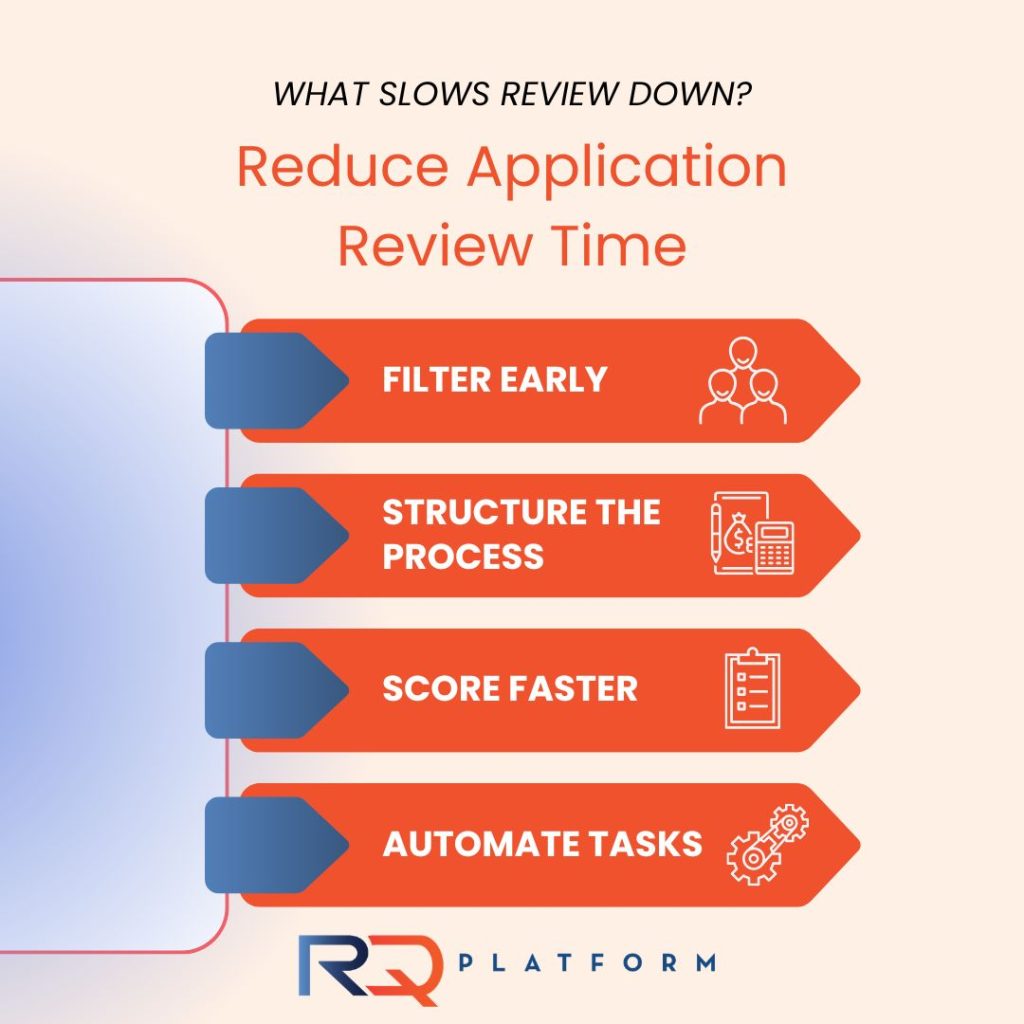
The Hidden Cost of Slow Reviews
Before diving into solutions, let's quantify the problem.
Average Program Staff Burden Per Application:
Initial screening & intake: 15 minutes
Preparing files for reviewers: 10 minutes
Coordinating reviewer assignments: 20 minutes
Tracking reviewer completion: 15 minutes
Consolidating scores and feedback: 20 minutes
Total per app: ~80 minutes
For a 500-application program with 5 staff members, this adds up to 667 hours of labor. If reviews are stalled due to poor coordination, that number easily reaches 900+ hours.
At an average salary of $55k/year ($26/hour), a 6-week review process costs roughly $23,400 in direct labor for a mid-sized program.
But there's a hidden cost: delayed decisions cost money too. Winners often have competing offers. The longer you take to notify winners, the higher your decline rate. Programs that notify within 2 weeks see 92% acceptance; those who wait 4+ weeks see only 78% acceptance.
Slow reviews don't just cost time, they cost outcomes.
Structural Bottleneck #1: Sequential Review Workflows
The Problem: One Reviewer at a Time
In basic systems (or manual processes), reviews typically follow a serial pattern:
Reviewer 1 completes all applications
Reviewer 2 gets the stack
Reviewer 3 handles discrepancies
Staff manually reconciles scores
This sequential approach might sound orderly, but it's the slowest possible way to review applications.
If each reviewer takes 8 hours to assess 100 apps, serial review takes 24+ hours of calendar time before any decisions emerge. Factor in reviewer availability, email delays, and follow-ups, and you're looking at 2-3 weeks for a single round.
The RQ Platform Solution: Parallel Multi-Stage Workflows
RQ Platform's configurable workflows enable reviewers to work simultaneously:
Parallel Assignment: All reviewers get their assigned applications at once — they work at the same pace, not sequentially.
Conditional Logic: Direct applications to specific reviewers or review tracks based on category, amount, or criteria.
Structured Review Stages:
Stage 1: Initial screening (pass/fail threshold)
Stage 2: Blind detailed scoring (only qualified apps move forward)
Stage 3: Committee review (if needed)
Real Example: A scholarship program with 800 applications traditionally took 6 weeks. By moving to parallel, category-based workflows in RQ Platform, they compressed the cycle to 3.5 weeks while improving consistency.
Why This Works:
Reviewers aren't waiting for predecessors
Multiple review stages happen simultaneously (screeners don't wait for scorers)
Unqualified applications are filtered early, reducing downstream load
Calendar time drops dramatically
Structural Bottleneck #2: Invisible Progress and Lost Context
The Problem: Where Is Everything?
Program managers running multiple reviewers across spreadsheets or email face the same question repeatedly: "Where's the status of my batch?"
Without a shared source of truth, coordination becomes tribal knowledge. Staff send emails, chase down missing scores, and manually log completion percentages.
Reviewers get confused: "Do I score all applicants or just the shortlist? And what's the deadline again?"
The RQ Platform Solution: Reviewer Dashboards and Real-Time Progress Tracking
RQ Platform's reviewer interface combines clarity with structure:
Explicit Assignments: Each reviewer sees their exact workload, deadlines, and instructions (no guessing).
Progress Indicators: Real-time completion status, managers see exactly which applications are scored, pending, or flagged.
Embedded Rubric: Reviewers never leave the platform to find criteria, side-by-side application and rubric scoring eliminates context switching.
Structured Comments: Forced guidance (required fields, character limits) ensures feedback is actionable, not vague.
Impact: Instead of email chasing, program managers can spot that Reviewer #2 is behind on a specific category and re-assign applications in real time.
Programs report 25-35% faster completion rates when reviewers have clear, real-time dashboards.
Structural Bottleneck #3: Bias, Rework, and Secondary Reviews
The Problem: Inconsistency Means Rework
When reviewers score independently without seeing each other's assessments, inconsistencies emerge. One reviewer rates an application 8/10; another rates the same app 5/10. Suddenly, reconciliation becomes a negotiation.
This triggers additional meetings, secondary reviews, and appeals adding weeks to the timeline.
Bias is another hidden time sink. When reviewers see applicant names, reviewer bias can unconsciously lower scores for underrepresented groups. Programs then have to re-score, adjust, or defend decisions all process overhead.
The RQ Platform Solution: Blinded Reviews and Structured Scoring
Blind Review Mode: Redacts applicant names, institutions, and identifying details during initial scoring. This reduces bias and helps ensure decisions are merit-based.
Calibration: Reviewers score the same set of applications before the full batch, identifying scoring misalignment before the real work begins.
Weighted Rubrics by Category: Instead of subjective overall scoring, RQ Platform enforces category-based rubrics with predefined weights one reviewer can't score "potential" as 50% and another as 10%; the rubric is fixed.
Result: Fewer appeals, less rework, faster consensus.
A medical education fellowship program using blinded review with structured rubrics cut their final review stage from 5 days to 1.5 days, because there was far less inconsistency to reconcile.
Making It Stick: The 40% Timeline Reduction Blueprint
Step 1: Map Your Current Workflow (Weeks 1-2)
Before implementing, document current review timelines:
When do applications close?
When does review actually start?
How long is each review stage?
What delays typically occur?
Use this baseline to measure improvement.
Step 2: Redesign for Parallelization (Weeks 2-4)
Identify which review stages can overlap
Define clear "pass/fail" gates to eliminate low-quality apps early
Separate screeners from detailed scorers
Assign reviewers to specific categories if your program has them (grants by sector, scholarships by major, etc.)
Step 3: Implement Structured Workflows (Weeks 4-6)
Set up parallel, multi-stage workflows in RQ Platform
Configure automated routing and conditional logic
Set clear deadlines for each stage with reviewer notifications
Test with a pilot batch of 50-100 apps first
Step 4: Enable Blinded Review (Weeks 6-8)
Activate blind review mode for sensitive categories
Run a calibration exercise with 10-20 "standard" applications to align reviewer scoring
Collect feedback on rubric clarity before rolling out fully
Step 5: Monitor and Iterate (Week 9+)
Track completion rates daily via dashboards
Identify bottlenecks in real time
Adjust reviewer assignments or deadlines as needed
Collect post-review feedback to refine the next cycle
Timeline Reality Check: Even with RQ Platform, you need 2-3 weeks for reviews. But by eliminating dead time, parallelizing work, and reducing rework, you'll see 30-40% compression compared to legacy systems.
Key Takeaways
Sequential workflows are invisible efficiency killers. Parallel review stages cut calendar time by eliminating handoffs and wait states.
Reviewers working blind produce better, faster decisions. Blinded review reduces bias and inconsistency, fewer appeals mean less rework.
Real-time dashboards replace email chasing. Managers who see exact progress can spot delays immediately and re-assign work dynamically.
Structured rubrics eliminate subjective scoring debates. Weighted, category-based rubrics mean fewer reconciliation meetings and faster consensus.
Savings compound. Faster reviews lead to higher acceptance rates, which lead to better outcomes, cutting review time by 40% also improves your program's competitiveness for top talent.
Common Questions About Faster Application Reviews
How much faster will reviews actually be with a better platform?
Most programs see a 30-40% reduction in calendar time, a program that takes 6 weeks with manual processes typically drops to 4 weeks with the right tools in place. The key driver is parallelization: when multiple reviewers work simultaneously and have instant clarity on what to score, bottlenecks disappear. Actual improvement depends on your current workflow.
What if our reviewers are volunteers we can't manage tightly?
Volunteers actually benefit more from clear systems, not less. When they can log in and immediately see what's assigned, the deadline, and the scoring criteria, they're more likely to complete on time without close oversight. Dashboard-based interfaces are built for reviewers who check in periodically rather than staff who are online all day, and automated reminders help fill the gap.
Can multiple reviewers still score the same application?
Yes, assigning several reviewers to one application and tracking all scores simultaneously is standard practice, and consensus scoring (like an average across reviewers) can be calculated automatically rather than reconciled by hand.
Conclusion
The programs that cut review time aren't necessarily working harder or hiring more reviewers, they're removing the structural bottlenecks that make sequential coordination, invisible progress, and inconsistent scoring so slow in the first place. Parallel workflows, real-time visibility, and structured rubrics address three separate failure points, which is why they compound: fixing only one tends to shift the bottleneck rather than remove it. Programs that treat review-time reduction as a process to design, rather than a staffing problem to solve, are the ones that see it stick cycle after cycle.
READY TO SIMPLIFY YOUR PROGRAM?
Your Program Deserves Better Than Spreadsheets.
RQ Platform brings applications, reviews, communications, reporting, and program management together—so your team can spend less time on admin and more time creating impact.