Key KPIs in Application & Review Management: What Program Managers Should Really Measure

What KPIs actually mean in application and review management, and which ones are worth tracking.
Key KPIs in Application & Review Management: What Program Managers Should Really Measure
Execution alone doesn't make a program successful. Whether you're managing awards, scholarships, grants, or fellowships, success comes from understanding performance across every stage. To do that, you need the right metrics.
Key performance indicators (KPIs) provide that visibility. They go beyond surface-level numbers and help you measure efficiency, identify gaps, and improve outcomes across your entire program lifecycle. In this article, we break down what KPIs mean in application and review management, why they matter, and which ones you should be tracking.
What Does KPI Mean in Program Management?
A KPI is a measurable value that shows how effectively a process or program is achieving its goals. In application and review management, KPIs provide insight into:
Application performance and completion
Review efficiency and timelines
Applicant and reviewer experience
Overall program impact
With the right KPIs in place, you gain a clear, data-driven view of how your program is performing.
Why KPIs Are Crucial
Modern programs involve multiple moving parts applications, eligibility checks, reviews, communications, reporting, and post-program tracking. Without KPIs, it's easy to lose visibility.
Tracking the right metrics helps program managers:
Identify bottlenecks early
Improve operational efficiency
Ensure fairness and consistency in reviews
Create transparency for stakeholders
Make informed, data-driven decisions
Ultimately, KPIs are what turn a functional program into a high-performing one.
Example KPIs for Your Program
1. Application Performance Metrics
Number of applications: Indicates how visible and attractive your program is. Growth year-over-year signals strong outreach.
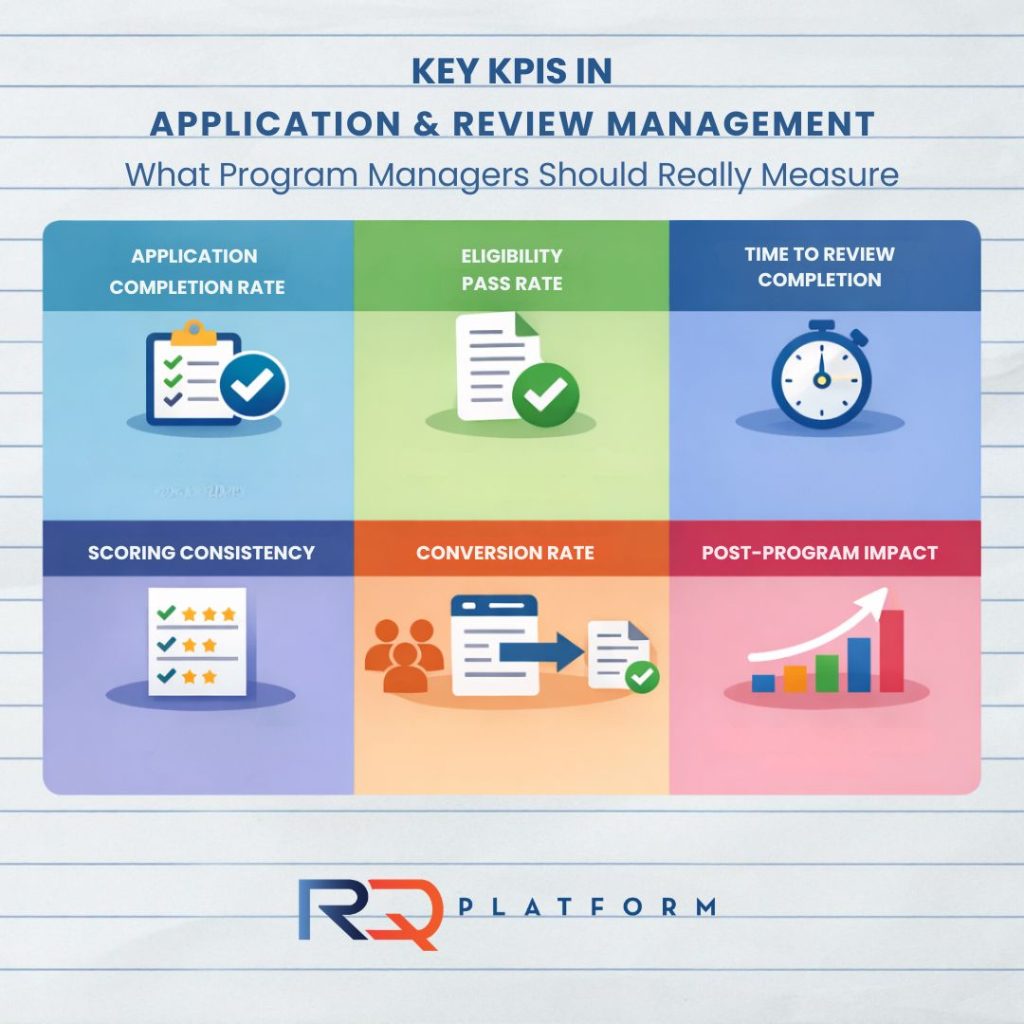
Application completion rate: Measures how many applicants start and successfully submit. Low completion rates often point to friction in the form or unclear requirements.
Tip: Monitor submissions regularly so you can adjust marketing or messaging before deadlines.
2. Eligibility and Applicant Quality
Eligibility pass rate: Shows how many applicants meet your criteria. A low rate may indicate misaligned targeting or unclear requirements.
Application quality: Average scoring or reviewer feedback can reveal whether you are attracting the right candidates.
Tip: Use eligibility screening early to reduce review workload and improve overall efficiency.
3. Evaluation KPIs
Time to review completion: Tracks how long it takes reviewers to complete evaluations. Long timelines can delay results and frustrate applicants.
Scoring consistency: Large variations between reviewers may indicate unclear criteria or a lack of alignment.
Tip: Structured rubrics and clear scoring frameworks improve both speed and fairness.
4. Time and Workflow Management
Cycle time: Measures how long each stage takes from application launch to final decision.
Deadline adherence: Tracks whether internal teams and reviewers meet timelines.
Tip: Identifying delays early allows you to adjust workflows and keep your program on track.
5. Engagement and Communication KPIs
Conversion rate (visitor > applicant): Shows how effectively your program turns interest into submissions.
Email engagement (opens and clicks): Indicates whether your messaging is resonating with your audience.
Tip: Strong communication directly impacts both application volume and quality.
6. Post-Program Impact
Outcome tracking: Measures what happens after the program: recipient progress, reporting, or long-term impact. This is critical for demonstrating ROI and program success to stakeholders.
Using KPIs Effectively
Tracking KPIs is only valuable if you act on them. Start by defining clear goals before your program launches. Monitor performance regularly and adjust where needed small changes like improving form usability or refining reviewer workflows can have a significant impact.
Equally important is transparency. Sharing KPI insights with your team keeps everyone aligned and accountable throughout the program cycle.
Frequently Asked Questions
What's the difference between a KPI and a regular metric?
A metric is any number you can track; a KPI is a metric tied directly to whether the program is achieving its goals. Application volume is a metric application completion rate tied to a target is a KPI, because it tells you whether something needs to change. RQ Platform's reporting dashboards are built around this distinction, surfacing the KPIs that map to action rather than raw activity counts.
Which KPI should a new program track first?
Application completion rate is a good starting point for most programs, since a low rate usually points to a specific, fixable problem (form length, unclear eligibility, confusing instructions) rather than a broader outreach issue. RQ Platform tracks completion rate automatically as part of its application analytics, so this is available from day one without extra setup.
How often should KPIs be reviewed during a program cycle?
Regularly enough to act on them before it's too late to matter, for time-sensitive KPIs like completion rate or deadline adherence, weekly or bi-weekly review during an active cycle is common, with post-cycle KPIs like outcome tracking reviewed after the cycle closes. Because RQ Platform updates reporting in real time, program managers can check these numbers as often as needed without waiting on a manual export.
Do smaller programs need to track as many KPIs as larger ones?
Not necessarily all of them at once. Smaller programs often get the most value starting with two or three KPIs tied to their biggest known pain point (for example, completion rate or reviewer turnaround time) rather than trying to instrument everything immediately. RQ Platform's configurable dashboards let teams start narrow and add more KPIs as the program grows, rather than committing to a fixed reporting setup upfront.
Why does scoring consistency matter as a KPI?
Large variation between reviewers' scores on similar applications often signals unclear criteria or a lack of shared understanding of the rubric, left unaddressed, it can undermine both fairness and the defensibility of final decisions. RQ Platform's structured rubrics and scoring reports make this kind of variation visible early, before it affects final selection outcomes.
Conclusion
KPIs are more than metrics on a dashboard, they provide clarity, improve fairness, and enable better decision-making at every stage of a program. As programs become more competitive and complex, data-driven management stops being optional and becomes the difference between a program that runs and one that improves every cycle. The goal isn't to track everything; it's to track what actually changes a decision.
READY TO SIMPLIFY YOUR PROGRAM?
Your Program Deserves Better Than Spreadsheets.
RQ Platform brings applications, reviews, communications, reporting, and program management together—so your team can spend less time on admin and more time creating impact.