How to Launch a Successful Mentorship Program: An 8-Step Guide for Program Managers

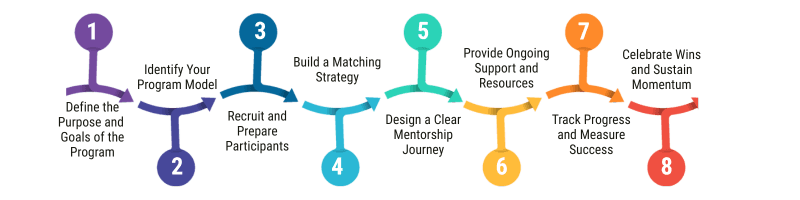
An 8-Step Framework for Building a Mentorship Program That Works
Mentorship programs can spark personal and professional growth for participants, but only if they are well-planned, intentionally structured, and thoughtfully executed. This guide walks program managers through the key stages of launching an engaging and successful mentorship program.
1. Define the Purpose and Goals of the Program
Start with a clear "why." A well-defined purpose ensures your mentorship program aligns with your organization's mission and meets participant needs.
Ask yourself:
What are the primary goals? (e.g., skill development, leadership training, career guidance, DEI support)
Who will the program serve? (students, early-career professionals, members, employees)
What outcomes do you want to measure?
Tip: Tie your goals to specific KPIs such as satisfaction scores, retention, promotions, or project completions.
2. Identify Your Program Model
Choose a structure that suits your participants and objectives.
Popular mentorship formats:
1-on-1 mentoring: Traditional, personal, and flexible.
Peer-to-peer: Builds shared accountability and mutual support.
Group mentoring: One mentor with multiple mentees, or peer learning circles.
Flash mentoring: Short-term or one-time sessions for specific advice.
Hybrid: A mix of formats to meet different learning styles.
Tip: 1-on-1 mentoring works best for deep developmental goals, while group or flash models can scale more easily.
3. Recruit and Prepare Participants
Effective recruitment ensures diversity, commitment, and alignment.
Steps to take:
Send an interest survey to gauge needs and availability.
Use clear role descriptions and time expectations for mentors and mentees.
Ensure buy-in by promoting benefits: networking, learning, leadership development.
Host an onboarding session to explain goals, expectations, and timelines.
Tip: Vet mentors to ensure they are skilled, available, and invested in helping others grow.
4. Build a Matching Strategy
Great matches lead to stronger engagement and outcomes.
Options:
Manual matching: You assign based on goals, experience, and preferences.
Self-matching: Participants choose based on bios or areas of expertise.
Algorithm-assisted matching: Use software to automate based on inputs.
Tip: Use a combination of interests, goals, communication styles, and availability for best-fit pairings.
5. Design a Clear Mentorship Journey
Structure gives the relationship momentum and helps guide meaningful conversations.
Include:
Program length (e.g., 3, 6, or 12 months)
Number of meetings recommended per month
Task and goal-setting templates or discussion guides
Check-ins and mid-point reviews
Wrap-up reflections or celebration events
Tip: Offer a mentorship toolkit with worksheets, conversation starters, and progress trackers.
6. Provide Ongoing Support and Resources
Even experienced professionals benefit from guidance.
Support your mentors and mentees with:
Training sessions or webinars
Office hours or program liaisons
Access to learning materials
Communication tips and DEI practices
Troubleshooting help if matches aren't working
Tip: Encourage feedback loops so participants feel heard and supported. Give mentors and mentees a way to share a personal status update on how the relationship is going, so you can learn more about why a match may not be working well.
7. Track Progress and Measure Success
A data-informed approach helps you improve the program over time.
Measure:
Connections (number of people who have or have not connected)
Engagement (number of sessions, attendance)
Participant satisfaction (surveys at midpoint and end)
Goal achievement (as defined by mentees/mentors)
Qualitative feedback and testimonials
Tip: Include anonymous pulse checks and an end-of-program evaluation to capture lessons learned.
8. Celebrate Wins and Sustain Momentum
Recognition reinforces value and encourages long-term involvement.
Ideas to consider:
Host a wrap-up celebration or showcase
Share participant success stories
Offer certificates or digital badges
Invite standout mentors back as ambassadors
Use feedback for case studies and to scale future programs
Tip: Keep your mentorship community alive through alumni groups, social channels, or seasonal refresh cycles.
Final Thoughts: Keys to a Successful Mentorship Program
Be intentional: Don't rush the planning phase; clarity now saves confusion later.
Stay flexible: Be ready to adapt based on participant feedback.
Foster relationships: Prioritize human connection over rigid structure.
Communicate often: Keep participants informed, engaged, and inspired.
With the right foundation, your mentorship program will empower people, spark growth, and become one of your organization's most impactful initiatives.
READY TO SIMPLIFY YOUR PROGRAM?
Your Program Deserves Better Than Spreadsheets.
RQ Platform brings applications, reviews, communications, reporting, and program management together—so your team can spend less time on admin and more time creating impact.