Program Governance 101: Building Audit Trails and Transparency Into Every Stage

A practical framework for embedding audit trails, accountability, and transparency into every stage of your awards program
When an awards program lacks clear governance, trust erodes fast. Questions surface about who made the decision, why, and based on what criteria. For organizations running recognition programs across multiple teams, departments, or partner networks, these questions can quickly become reputational risks.
The good news: strong program governance isn't complicated to establish; it just requires intention. This guide walks through the core principles, the stages where transparency matters most, and how the right tools can make compliance effortless.
Why Governance Is the Foundation of Every Awards Program
Governance is more than a compliance checkbox. It's the framework that defines how decisions get made, who has authority at each stage, and how the process can be reviewed or challenged. Without it, even well-intentioned programs can appear or actually be biased, inconsistent, or opaque.
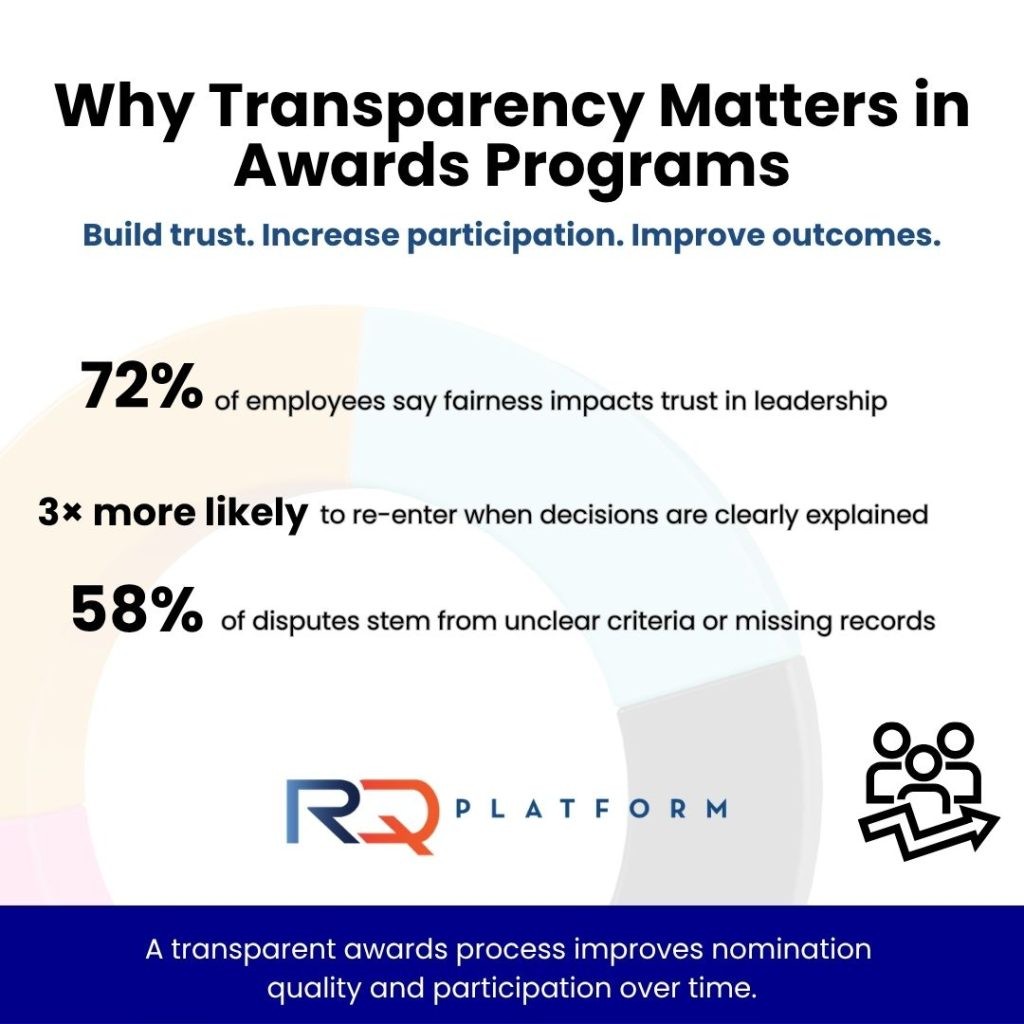
72% of employees say fairness in recognition programs affects their trust in leadership
Participants are more likely to re-enter a program when past decisions were clearly explained
58% of program disputes stem from unclear evaluation criteria or missing records
A transparent awards process isn't just about protecting the organization, it actively improves the quality of nominations and participation rates over time.
Audit-Ready Governance Across Every Stage
Transparency must be built into each phase of the awards lifecycle, not retrofitted after the fact. Here's what that looks like in practice:
1. Program Design and Criteria Setting
Document eligibility requirements, scoring rubrics, and weighting before the program opens. Store version history so any mid-cycle changes are traceable with timestamps and approver names.
2. Nomination and Submission Collection
Capture submission metadata, who submitted, when, and from which program or channel. Award management software should log every edit, withdrawal, or admin override with a reason code attached.
3. Review and Scoring
Record each reviewer's scores, comments, and conflict-of-interest declarations. Blind review settings should be logged alongside the unmasking event if applicable. No score should be unattributed.
4. Decision and Approval Workflow
Multi-level approvals should generate a clear chain of custody: who approved, who escalated, and when final sign-off was granted. Store this against each record, not just in email threads.
5. Announcement and Post-Program Review
Winners, runners-up, and disqualified entries should each have a clear, retrievable rationale. Post-program audits become effortless when your records are structured from day one.
What to Look for in Award Management Software
Not all platforms are created equal. When evaluating award management software for your awards programs, prioritize tools that make governance invisible to participants but bulletproof for administrators.
Automatic, tamper-evident timestamping on every action
Role-based access logs showing who viewed, edited, or approved each record
Exportable audit reports for internal reviews or external compliance requests
Version history on criteria documents, scoring rubrics, and eligibility rules
Conflict-of-interest flagging and recusal tracking built into reviewer workflows
Cross-program visibility for administrators managing multiple concurrent awards
"The best governance frameworks are the ones no one notices because they're working exactly as designed."
Cross-Program Governance: Managing Consistency at Scale
Organizations running multiple awards programs face a compounded governance challenge. Each program may have different stakeholders, timelines, and criteria, but the transparency standards should be universal.
A cross-program governance model establishes shared policies (conflict of interest, data retention, escalation paths) while allowing individual programs to configure their own criteria and scoring. The result: a transparent process that scales without creating administrative chaos.
Key elements of a cross-program governance policy:
A centralized policy document that all programs inherit, with program-level override permissions clearly defined
A shared audit log infrastructure so governance reports can be run across programs simultaneously
Standardized reviewer training and conflict-of-interest declaration processes
A single escalation path for disputes, regardless of which program triggered the issue
5 Quick Wins to Strengthen Your Program Governance Today
You don't need to overhaul everything at once. Start with these high-impact changes:
Publish your criteria publicly: before submissions open, not after. This alone reduces perceived bias significantly.
Assign a Governance Owner: one named person responsible for audit readiness on each program.
Retire email-based approvals: move final decisions into your platform where they're automatically logged.
Schedule a post-program audit: even a 30-minute review of the audit trail builds muscle memory and surfaces gaps.
Version-control your rubrics: if criteria change mid-cycle, document why and when. Retroactive justification is always weaker than proactive logging.
Common Questions About Awards Program Governance
What's the difference between compliance and governance for awards programs?
Compliance is about meeting a specific external requirement; governance is the broader, ongoing framework, clear criteria, defined authority, and documented decisions, that makes compliance a natural byproduct rather than a separate scramble.
How much documentation does an audit-ready awards program actually need?
At minimum: version-controlled criteria and rubrics, a timestamped record of who reviewed and approved each decision, and a retrievable rationale for winners, runners-up, and disqualified entries. Programs that log this as they go need far less reconstruction later than programs trying to document after the fact.
Can governance policies work across multiple concurrent award programs?
Yes. A shared policy layer (conflict of interest, data retention, escalation paths) can apply universally while each individual program still configures its own criteria and scoring, which keeps standards consistent without forcing every program into an identical structure.
Governance Isn't Overhead, It's a Competitive Advantage
Organizations that invest in program governance don't just protect themselves from scrutiny, they build the kind of credibility that makes their programs worth entering in the first place. Participants nominate more confidently. Reviewers engage more rigorously. Leadership trusts the outcomes.
Conclusion
Governance problems rarely announce themselves until a decision gets challenged and by then, reconstructing who decided what, when, and why is far harder than it needed to be. Programs that document criteria, log decisions, and version-control their rubrics from day one aren't doing extra work; they're just doing the same work at a better time. That shift, more than any single tool, is what turns governance from a defensive afterthought into a genuine source of program credibility.
AUDIT-PROOF BY DESIGN
Make every decision defensible
See how RQ Platform logs every review, approval, and change automatically.