The Hidden Costs of Manual Application Review (And How to Fix Them)

The real operational costs of manual application review, and what a modern, managed process looks like instead.
The Hidden Costs of Manual Application Review (And How to Fix Them)
If your team is still managing applications through spreadsheets, email threads, or disconnected tools, you're not alone. Many programs across awards, scholarships, grants, and fellowships start this way. It works in the early stages, when volume is manageable and processes are simple.
But as programs grow, manual workflows begin to introduce friction. What once felt flexible quickly becomes inefficient, inconsistent, and difficult to scale. This article breaks down the real operational costs of manual application review, and how modern platforms like RQ Platform are helping organizations eliminate them.
Why Manual Review Still Exists
Manual processes persist for one reason: familiarity. Teams are comfortable with spreadsheets. Email feels easy. Shared folders seem manageable.
But these tools were never designed to support:
Multi-stage evaluations
Reviewer collaboration
Audit tracking
Structured scoring
Program-wide reporting
As complexity increases, these gaps become more visible and more costly.
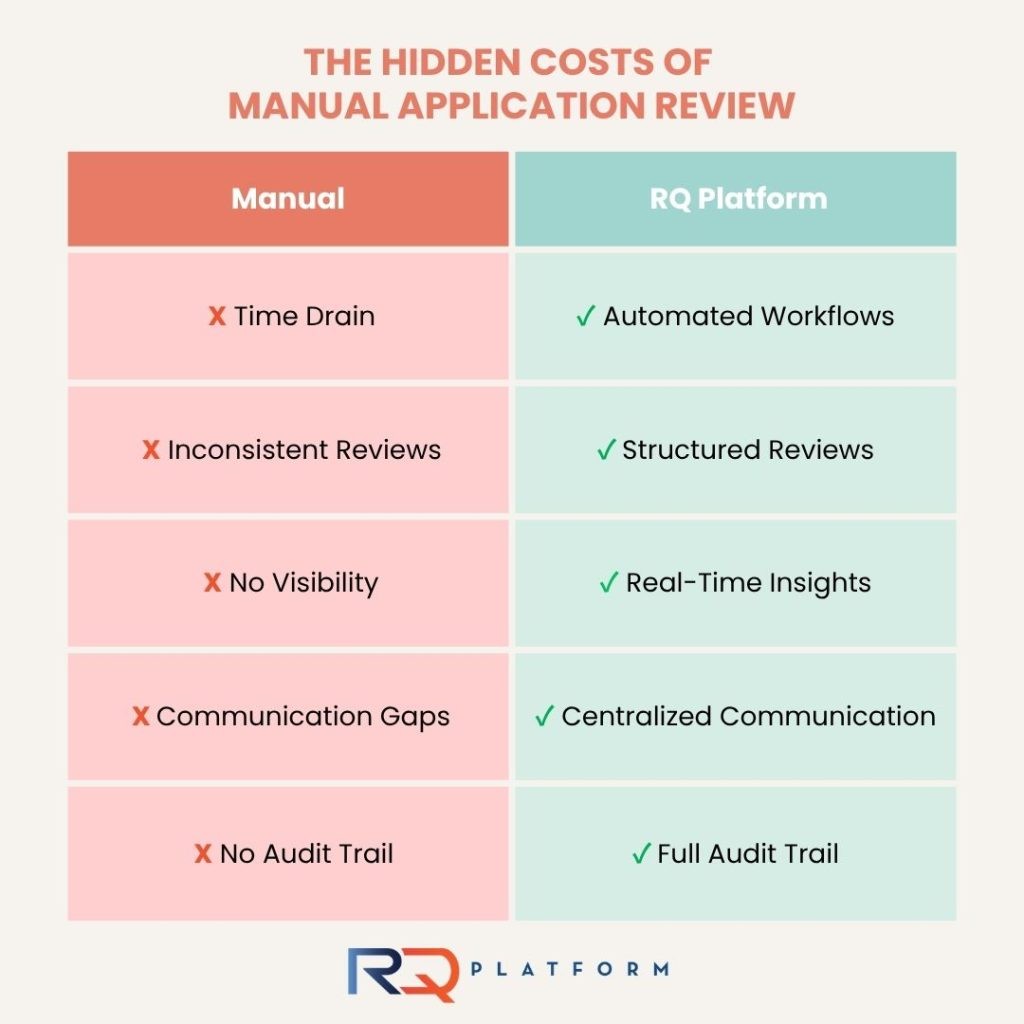
The 5 Hidden Costs of Manual Application Review
1. Time Loss Across Every Stage
Manual review introduces inefficiencies at every step:
Assigning reviewers manually
Chasing incomplete submissions
Consolidating scores across files
Managing version control
What should take minutes often takes hours. And as application volume increases, the time cost compounds.
2. Inconsistent and Biased Evaluations
Without a structured review system, consistency becomes difficult to maintain. Reviewers may:
Interpret scoring criteria differently
Miss key information
Apply inconsistent standards
In some cases, reviewers may also see identifying applicant details, introducing potential bias. Structured workflows and blinded review processes help ensure fairness and alignment across evaluations.
3. Limited Visibility Into Program Performance
Manual systems make it difficult to answer basic questions like:
How long does each review stage take?
Where are applications getting stuck?
Which reviewers are most active?
What are average scores by category?
Without real-time visibility, program managers are forced to rely on guesswork instead of data.
4. Communication Breakdowns
Email-based workflows often lead to:
Missed reviewer invitations
Inconsistent messaging
Delayed responses
Confusion around deadlines
When communication isn't centralized, coordination becomes harder and errors increase.
5. Lack of Auditability and Compliance
For many organizations, especially in grants and awards, transparency is critical. Manual systems rarely provide:
Complete audit trails
Documented reviewer activity
Clear decision histories
This creates risk, particularly when programs need to demonstrate fairness or respond to inquiries. RQ Platform includes audit trail and history tracking across the full lifecycle, helping organizations maintain transparency and accountability.
What a Modern Application Review Should Look Like
As programs scale, the goal isn't just to digitize processes it's to structure them. A modern application and review system should provide:
Centralized Intake and Eligibility Screening
Applicants should move through a clear, guided process with built-in eligibility checks and conditional logic.
Configurable, Multi-Stage Review Workflows
Programs should be able to define multiple review phases, assign reviewers, and manage scoring consistently.
Blinded and Structured Evaluations
Removing identifying information and standardizing rubrics helps reduce bias and improve fairness.
Automated Communication
Notifications, reminders, and updates should be triggered automatically based on program activity.
Real-Time Reporting and Insights
Program managers should be able to track progress, identify bottlenecks, and measure performance at any stage.
Post-Program Tracking
The process doesn't end at selection. Tracking outcomes and follow-ups is essential for long-term program success.
RQ Platform supports all of these capabilities within a single system from application intake to post-program tracking with SmartTracker.
The Shift From Manual to Managed
Moving away from manual processes isn't just about saving time. It's about creating a program that is:
Easier to manage
More consistent in evaluation
More transparent and defensible
Better equipped to scale
Organizations that make this shift often see immediate improvements in efficiency, reviewer experience, and applicant satisfaction.
A Quick Reality Check
If your team is currently:
Exporting and merging spreadsheets
Manually assigning reviewers
Tracking progress through email threads
Rebuilding reports at the end of each cycle
You're likely spending more time managing the process than improving it.
Frequently Asked Questions
At what point does manual application review start to break down?
Most teams notice it as application volume grows past what one or two people can track by hand reviewer assignments get missed, scores live in scattered files, and answering a simple question like "where are we stuck?" takes real digging instead of a quick check.
How does manual review introduce bias into evaluations?
When reviewers see identifying applicant details alongside their scoring, unconscious bias can creep in even with good intentions. Structured, blinded review processes remove that risk by separating identifying information from the evaluation itself.
What's the difference between digitizing a process and structuring it?
Digitizing just moves a spreadsheet into a form or shared file the same gaps in consistency, visibility, and audit tracking remain. Structuring means building in defined review stages, standardized scoring, and automatic logging, so the process itself is more reliable, not just less paper-based.
Why does auditability matter for grant and award programs specifically?
These programs often need to demonstrate fairness to funders, boards, or auditors after the fact. Without documented reviewer activity and clear decision histories, organizations are left reconstructing what happened from memory, which is a much weaker position than having a built-in audit trail.
What's a realistic first sign that it's time to move off manual review?
If your team is regularly exporting and merging spreadsheets, manually assigning reviewers, or rebuilding reports from scratch at the end of every cycle, that's usually a sign more time is going into managing the process than into the decisions the process is supposed to support.
Conclusion
Manual application review works until it doesn't. As programs grow, the cost of inefficiency becomes harder to ignore: hours lost to manual coordination, inconsistent scoring, and no clear record to point to when a decision gets questioned. The most effective organizations aren't just collecting applications they're running structured, scalable processes that support better decisions and hold up under scrutiny.
READY TO SIMPLIFY YOUR PROGRAM?
Your Program Deserves Better Than Spreadsheets.
RQ Platform brings applications, reviews, communications, reporting, and program management together—so your team can spend less time on admin and more time creating impact.