Designing a Fair & Accessible Scholarship Application Process

Six research-backed principles for building scholarship applications that reach the students who need them most
Scholarships change lives, but only if the application process is designed to be fair and accessible. Unfortunately, complex forms, unclear criteria, hidden costs, and accessibility gaps often prevent qualified students from even completing an application.
Programs that prioritize simplicity, transparency, and inclusion can attract more applicants, reduce barriers, and ensure opportunities reach those who need them most.
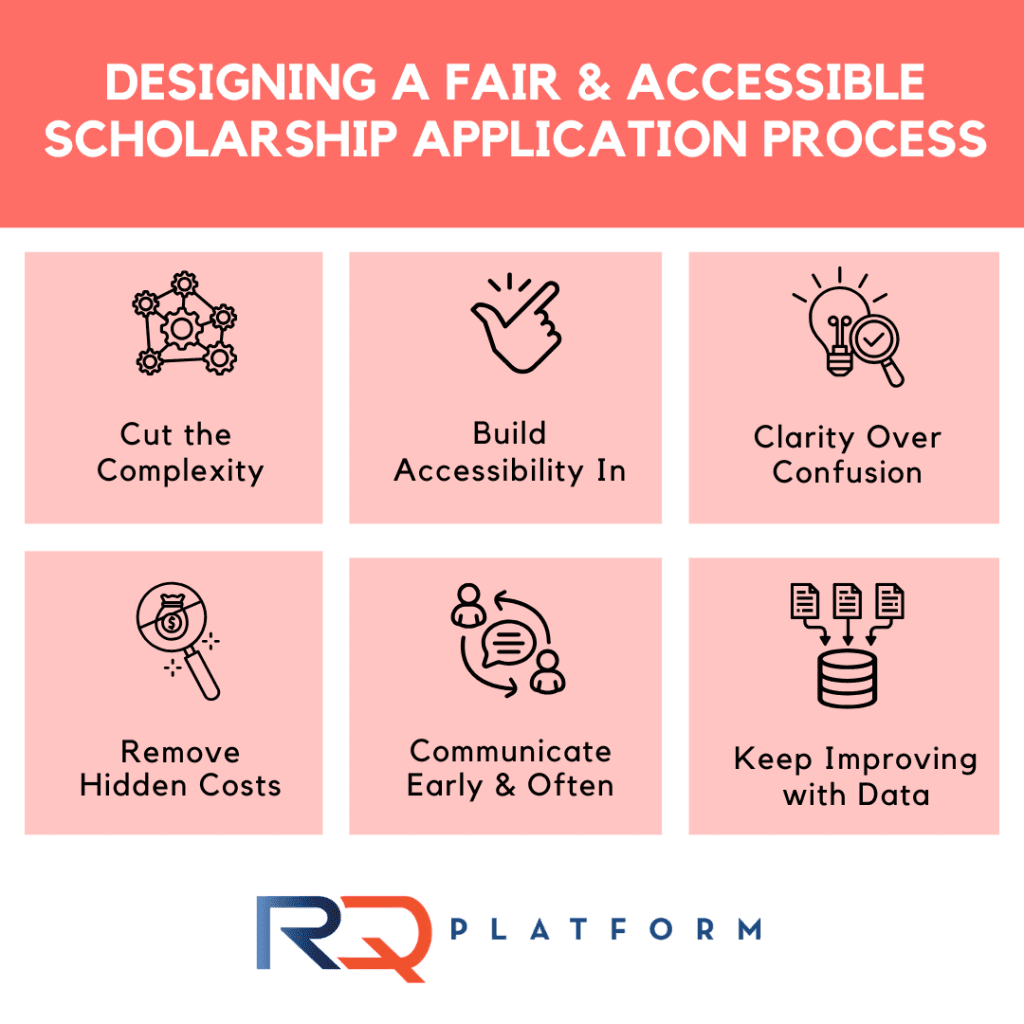
Cut the Complexity
Overly complicated forms create "application fatigue" and discourage students from finishing.
A Brookings study found that complex applications disproportionately hurt low-income and first-generation students, who are more likely to abandon the process when faced with multiple portals, essays, or documentation hurdles (Source: Brookings).
RQ Tip: With form logic and conditional display, RQ Platform ensures applicants only see questions relevant to them, simplifying the process.
Build Accessibility In
Fair access requires scholarship portals that work across devices and support assistive technology.
The Web Content Accessibility Guidelines (WCAG) set the global standard: forms must be perceivable, operable, and understandable to be equitable.
RQ Tip: RQ Platform provides accessible, mobile-friendly templates, helping programs meet WCAG standards.
Clarity Over Confusion
Applicants should never have to guess whether they're eligible. Ambiguity leads to lost opportunities.
Brookings reports that unclear eligibility and preparation gaps contribute directly to disparities in college enrollment (Source: Brookings).
RQ Tip: Use RQ Platform's eligibility screening tools to provide clear upfront guidance so students know whether they qualify before they start.
Remove Hidden Costs
Even small application fees discourage participation from students who need scholarships most.
A U.S. Treasury study found that process barriers, including fees and paperwork complexity, disproportionately block low-income students from accessing education-related financial benefits (Source: U.S. Treasury).
RQ Tip: RQ Platform offers flexible payment options (promo codes, fee waivers, discounts), or programs can remove fees entirely.
Communicate Early and Often
Students want transparency, not uncertainty. Clear updates throughout the application cycle keep them engaged.
Research from the College Board shows that timely communication improves application completion and student trust (Source: College Board Research).
RQ Tip: RQ Platform enables custom emails, reminders, and real-time status updates to keep applicants informed at every stage.
Keep Improving with Data
Accessibility isn't a one-off project, it requires continuous monitoring.
The U.S. Department of Education highlights the need for ongoing data collection to understand who applies, who completes, and who succeeds, so that inequities can be addressed (Source: U.S. Dept. of Education).
RQ Tip: With custom reports and RQ SmartTracker™, RQ Platform helps programs analyze applicant demographics, track outcomes, and refine accessibility year after year.
Common Questions About Fair and Accessible Scholarship Applications
Does simplifying a scholarship application reduce the quality of information collected?
Not when it's done well, the goal isn't asking fewer questions overall, it's using conditional logic (per "Cut the Complexity") so each applicant only sees the questions relevant to their specific situation. A student never sees an irrelevant section, but reviewers still get the full information they need for the applicants it actually applies to.
Is WCAG compliance a legal requirement, or just a best practice?
It depends on your organization and jurisdiction, some institutions (public universities, government-affiliated programs) face binding accessibility legal requirements, while for others it's a best practice rather than a legal mandate. Either way, WCAG's perceivable/operable/understandable standard is worth meeting regardless of whether it's legally required, since it directly affects how many qualified students can actually complete your application.
Can removing application fees actually make financial sense for a scholarship program?
Often yes, once you weigh it against what fees actually cost you: fewer qualified applicants, since the students most likely to be deterred by a fee are frequently the ones the scholarship is meant to reach. Flexible options like fee waivers or promo codes can preserve some fee revenue while removing the barrier for students who need it waived most.
How much does automated status communication actually reduce applicant drop-off?
The College Board research cited above ties timely communication directly to completion rates, though the exact effect size varies by program. The underlying mechanism is straightforward: applicants who don't know where they stand are more likely to assume the worst, lose interest, or simply forget to finish, than applicants receiving regular, clear updates.
What demographic data can we track without discouraging applicants from finishing?
Keep demographic questions optional, place them at the end of the application rather than the beginning, and explain briefly why you're asking (typically to monitor program reach and fairness). Optional, well-explained demographic questions tend not to affect completion rates the way mandatory or unexplained ones can.
Final Word
A fair and accessible scholarship process doesn't just open doors, it ensures those doors stay open for every qualified student. By simplifying forms, embedding accessibility, clarifying eligibility, removing barriers, and communicating transparently, programs can maximize both fairness and participation. With RQ Platform, you can build scholarship programs that are inclusive, efficient, and trusted.
READY TO SIMPLIFY YOUR PROGRAM?
Your Program Deserves Better Than Spreadsheets.
RQ Platform brings applications, reviews, communications, reporting, and program management together - so your team can spend less time on admin and more time creating impact.