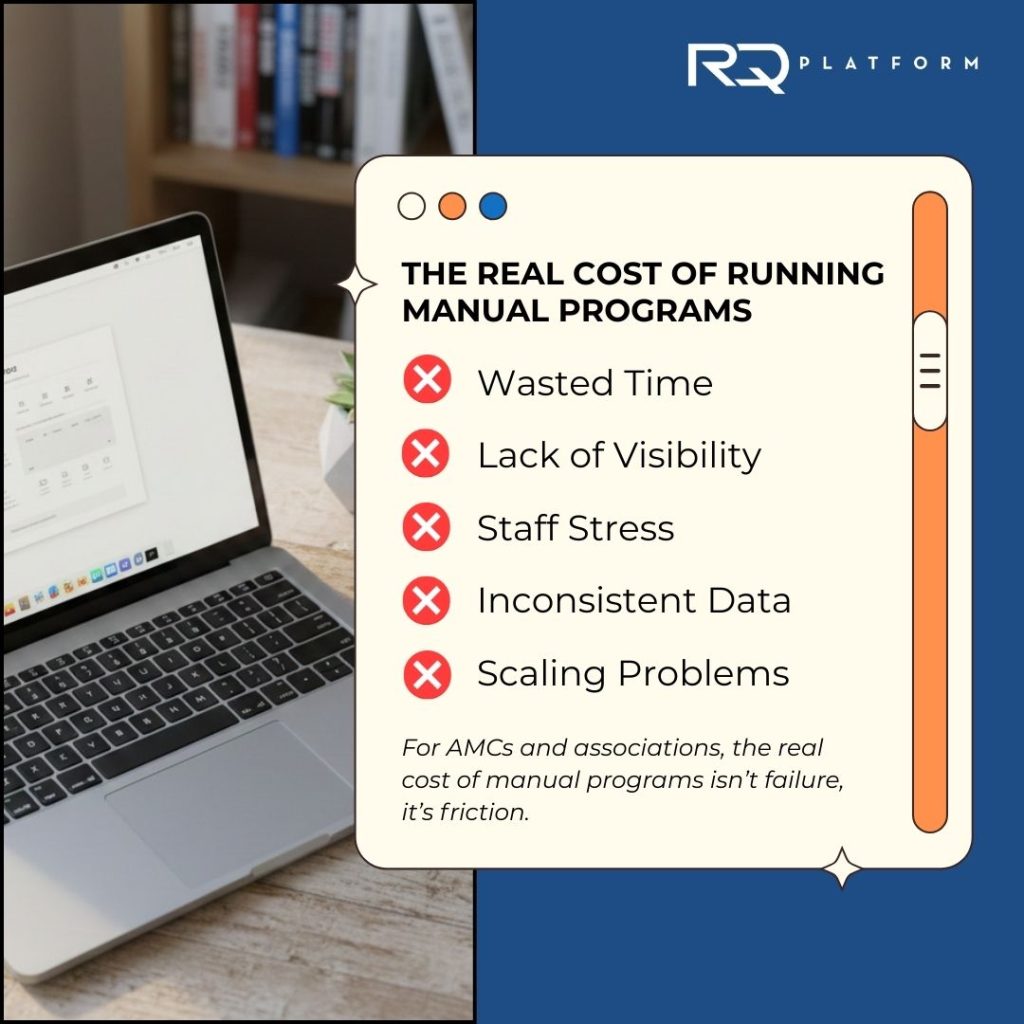
The Real Cost of Running Manual Programs

What research shows about why associations and AMCs are moving from manual coordination to structured program infrastructure
What Research Shows for Associations and AMCs
Associations and Association Management Companies (AMCs) are managing more programs, more stakeholders, and more reporting requirements than ever before, often with lean teams.
Email, spreadsheets, and shared folders have long been the default way to run awards, grants, scholarships, and fellowships. For a time, this approach worked. Research now shows that as programs scale, manual operations introduce real costs, primarily in staff time, consistency, and visibility.
What the Research Is Showing
Across industries, organizations are moving away from manual coordination toward structured, system-supported workflows.
McKinsey finds that digitized workflows reduce administrative effort and allow teams to focus on higher-value work rather than coordination.
Deloitte reports that modernizing routine processes improves productivity, governance, and employee experience in complex organizations.
NTEN's Nonprofit Technology Report shows nonprofits prioritizing internal operations systems to manage growing complexity with limited staff.
Gartner emphasizes that leaders make better decisions when operational data is available in real time, not reconstructed manually.
The message is consistent: manual processes don't fail, but they don't scale well.
This Matters More for AMCs Because...
AMCs operate in a more complex environment than single-program organizations, managing:
Different program rules and timelines
Rotating reviewers and committees
Ongoing client reporting
Frequent staff and volunteer changes
Research shows standardized, repeatable operations outperform one-off manual processes.
When workflows are structured:
Less time is spent coordinating
Knowledge stays in systems, not people
Programs remain consistent as teams change
Reporting becomes faster and more reliable
For AMCs, manual work doesn't just add effort it multiplies complexity with every new program or client.
The Shift: From Manual Coordination to Program Infrastructure
Leading organizations are not "adding more software." They are adopting program infrastructure systems designed specifically for repeatable, multi-program operations.
This is where platforms like RQ Platform come in. RQ Platform is purpose-built for organizations managing multiple programs and stakeholders, enabling teams to:
Run applications, reviews, and decisions in one system
Standardize workflows while preserving program-specific rules
Reduce manual coordination across reviewers and administrators
Gain real-time visibility across programs and clients
Produce consistent, audit-ready reporting without rebuilding data
For AMCs and lean association teams, this approach supports growth without increasing operational load.
Common Questions About Moving Off Manual Program Management
How do we know if our organization has actually outgrown spreadsheets and email?
The clearest signal isn't a single dramatic failure, it's accumulating friction: staff spending more time re-explaining program status than running the program, reviewers chasing each other over email, or reporting that takes days to assemble because data lives in five different files. RQ Platform centralizes applications, reviews, and reporting in one system specifically so that friction stops compounding as you add programs or clients.
Can a platform actually handle each program's own unique rules, or does everything get forced into one template?
This is the exact problem generic tools create for AMCs. RQ Platform is built to standardize workflows like application intake, reviewer assignment, and reporting formats, while still preserving each program's specific eligibility rules, timelines, and criteria, so consolidating onto one system doesn't mean flattening every client's program into an identical shape.
Will moving off manual processes create more work during the transition?
There's a setup cost, but it's front-loaded and one-time, unlike manual coordination costs, which recur every single cycle and grow as you add programs. RQ Platform's implementation is designed around getting multi-program, multi-client operations running without requiring a technical team on your end, so the transition cost is bounded in a way ongoing manual coordination never is.
Does structured program infrastructure help with client or board reporting specifically?
Yes, this is one of the areas where manual processes create the most hidden cost. When program data lives in one system rather than being reconstructed from spreadsheets each time, RQ Platform can produce consistent, audit-ready reporting on demand instead of requiring staff to rebuild a report from scratch for every board meeting or client check-in.
Is this only worth it for organizations managing a very high volume of programs?
Not necessarily. The tipping point is less about a specific number of programs and more about whether coordination is already consuming disproportionate staff time relative to the actual program work. Lean teams managing even a handful of concurrent programs, a common AMC scenario often feel this friction earlier than larger organizations with more staff to absorb the manual overhead.
Bottom Line
Manual program management has worked for years. Research now shows that as programs grow, structured, system-supported operations lead to better use of time, clearer oversight, and more sustainable scale.
For AMCs and associations, the real cost of manual programs isn't failure, it's friction. And unlike an outright failure, friction is easy to miss until a team is already stretched thin across too many programs to coordinate manually.
READY TO SIMPLIFY YOUR PROGRAM?
Your Program Deserves Better Than Spreadsheets.
See how RQ Platform replaces manual coordination with real-time program visibility.